
One Wisconsin. On Wisconsin.
Milwaukee taps UW–Madison research to replace highest-risk lead pipes
You are what you … drink? In Milwaukee, tens of thousands of households still receive drinking water through lead service lines. The pipes were installed in the 19th century and early 20th century, before medical research made clear that even a small amount of lead is toxic, particularly for small children.
Like many cities in the United States, Milwaukee faces complicated decisions about how to prioritize the replacement of lead pipes. That’s where a powerful tool built by researchers at the University of Wisconsin–Madison has become indispensable.
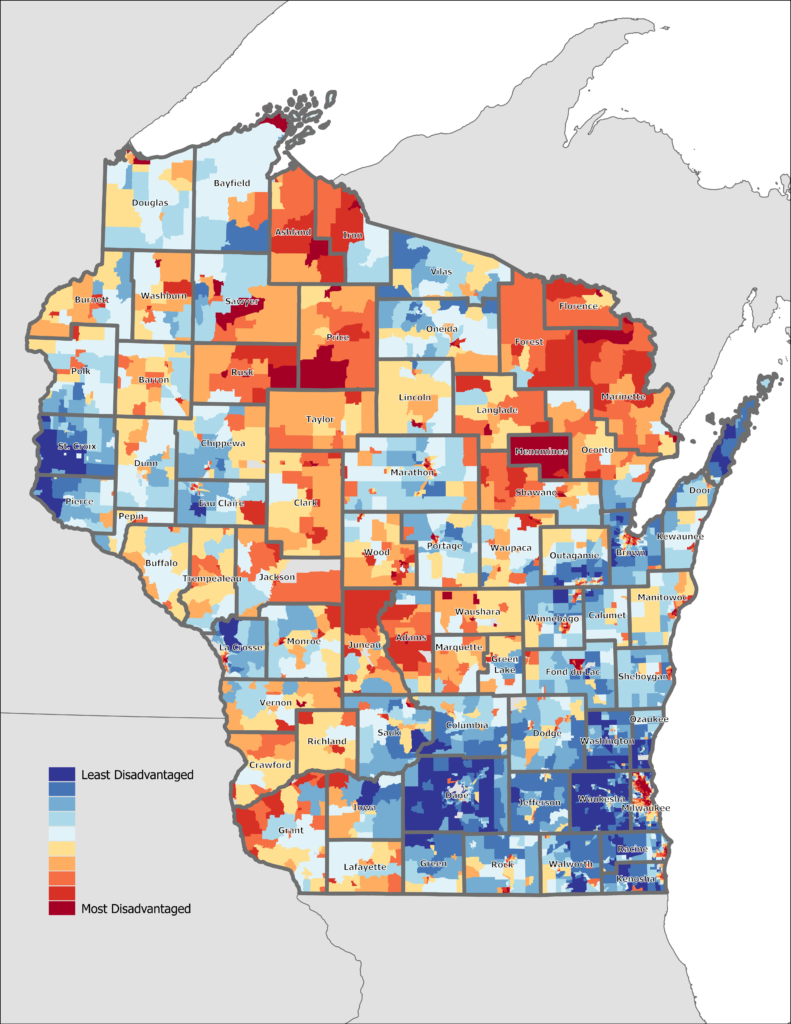
The Area Deprivation Index, or ADI, connects data related to employment, education, income and housing quality to U.S. Census data to provide a user-friendly map of American neighborhoods ranked by their relative advantage — or disadvantage. The free online tool helps organizations like Milwaukee Water Works target limited resources in addressing public health challenges.
The ADI is a project of the UW–Madison School of Medicine and Public Health’s Center for Health Disparities Research, a federally funded program that promises to improve policy decisions and transform how health care is delivered across the nation. The center’s researchers are also hard at work untangling the complex reasons why people in more disadvantaged areas tend to be sicker and die earlier.
A eureka moment
The Milwaukee water utility began incorporating the Area Deprivation Index into its strategy for replacing lead lines in 2024. That followed guidance from the U.S. Environmental Protection Agency and Wisconsin Department of Natural Resources that municipalities should include disadvantaged neighborhoods in their criteria for prioritizing replacement work.
Patrick Pauly, superintendent of Milwaukee Water Works, recalls learning about the Area Deprivation Index as a eureka moment. He was attending a conference for water utility professionals, and representatives of the Washington, DC, utility described how they were incorporating the ADI into their strategy for replacing lead lines.
“So we did some research, and the ADI provided exactly what we needed,” says Pauly.

That’s because its scoring system is simple and intuitive and based on factors the city needed to account for, including housing, income and education level. Built around census blocks, the Area Deprivation Index is also granular enough to provide actionable information about individual neighborhoods.
The ADI came into play as the utility worked with the city’s elected officials to change an ordinance that had previously required property owners to share the cost of replacing lead service lines — a prospect that was simply unrealistic in neighborhoods riddled with the old pipes.
In addition to changing that ordinance, the city adopted a new prioritization system built largely around the Area Deprivation Index. It significantly expanded the replacement program from around 1,100 replacements in 2023 to a goal of 5,000 in 2026 and beyond. The primary benefit of the ADI, Pauly says, is that it provides an evidence-based approach to expanding replacement work from individual homes to entire neighborhoods.
“Coming from the UW School of Medicine and Public Health and being online where people can look it up made the conversations so much easier,” says Pauly. “It was a very trusted, respected, simple and easily explained method that provided us a huge benefit.”
The air you breathe
The principle underpinning the Area Deprivation Index is that people’s overall health is determined not just by their genes but also the environments where they live and work.
“It’s the whole nature-versus-nurture idea — and the real answer is that it is both,” says Amy Kind, a geriatrician in the UW School of Medicine and Public Health and director of the Center for Health Disparities Research.
“We know that diseases like Alzheimer’s and cancer are partly determined by your genetics, but a whole bunch of it isn’t,” says Kind. “Things like your lifestyle, the air you breathe and the world around you play a huge role.”

While residents in urban neighborhoods face challenges like noise that disrupts their sleep and more days of poor air quality, Kind points out that rural life can carry its own health risks — ones that she herself may have been exposed to during her childhood deep in the Northwoods of Wisconsin in the tiny village of Niagara.
“Depending on where you live or where you grew up, you might be exposed to toxins like arsenic from your well water or pesticides from farms,” she says.
Where it’s harder to be healthy
For Kind, it’s personal, given her roots in rural Niagara.
“When we look at Niagara on the ADI, it’s one of the most disadvantaged places in Wisconsin,” she says. “When I’m writing a research grant for the National Institutes of Health, I am thinking about towns like Niagara, where it’s harder to be healthy. It’s my mission as a professor at UW–Madison to advance research that improves their lives.”
For more on this work, you can read Healing the World, Block by Block in On Wisconsin magazine.